FINANCING OPTIONS AVAILABLE FOR ALL SERVICES

BLOG
What Actually Happens After Water Damage
Posted On: February 18, 2026
And Why So Many Repairs Fail the Second Time
Water damage is one of the most common issues across multi-family properties, commercial buildings, and homes. It is also one of the most misunderstood.
Most people think the problem is the water itself. In reality, the real damage often begins after the visible water is gone.
Fans run. Surfaces dry. Walls get patched. Paint goes up. The space looks normal again.
But looking dry and being dry are not the same thing.
When “Dry” Is Only Surface Deep
After a leak or flood, the first focus is usually extraction and air movement. That is necessary, but it is only the beginning.
Water travels. It moves into insulation, under flooring, behind baseboards, and into framing. It follows gravity and structure. By the time it becomes visible on drywall, it has often already migrated further than expected.
If drying efforts focus only on what can be seen, moisture remains trapped in materials that were never opened or tested properly.
That is where repeat problems begin.
The Most Common Post-Water Mistakes
Across property types, the same shortcuts show up repeatedly:
- Replacing drywall without checking insulation behind it
- Painting over stained areas without confirming moisture levels
- Leaving wet subflooring under new flooring
- Failing to address the original source of intrusion
- Sealing cavities before full dry-out
In multi-family properties, speed is often the pressure point. Units need to turn quickly. In commercial settings, downtime costs revenue. In homes, disruption is stressful and expensive.
But rushing the drying and remediation phase almost guarantees a second repair.
Moisture Is Measured, Not Assumed
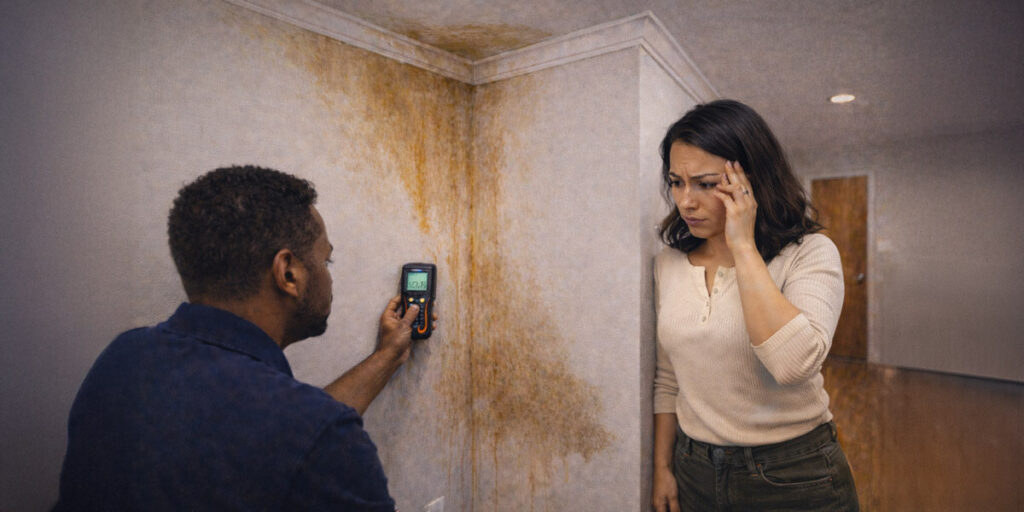
Professional remediation does not rely on appearance. It relies on readings.
Moisture meters, thermal imaging, and systematic testing determine whether materials are actually dry enough to close up. Without that verification, rebuilding becomes guesswork.
And guesswork is expensive.
When the Problem Comes Back
Repeat failures usually show up in predictable ways:
- Musty odors
- Bubbling paint
- Warped baseboards
- Soft drywall
- Mold growth in corners or closets
At that point, the repair is more invasive than it would have been the first time. Finished work must be removed. Occupants are displaced again. Costs multiply.
What could have been contained becomes a layered repair.
Water Damage Is a Sequence, Not a Single Event
Proper remediation follows an order:
- Identify and permanently fix the source of water
- Remove affected materials when necessary
- Dry all impacted areas thoroughly
- Verify moisture levels
- Rebuild correctly
Skipping steps or compressing the timeline disrupts the entire sequence.
This applies to a single-family home just as much as it does to a 200-unit property or a commercial suite.
The Bottom Line
Water damage is rarely expensive because of the initial event. It becomes expensive when it is not handled thoroughly.
Surface-level repairs create surface-level confidence. True remediation protects the structure, the finishes, and the long-term value of the asset.
Whether you manage a portfolio, operate a business, or own a home, the goal is not to make it look dry.
The goal is to make it right.

GET A FREE ESTIMATE
JD Lux Improvements gets the job done right. We would love to give you an estimate for the project you have in mind.